
Dryer Vent Inspection
Sometimes you don’t need a full cleaning — you need to know what you’re dealing with first. That’s what this service is for.
A Real Airflow Reading, Plus a Full Visual Check
We measure how much air is actually moving through your vent, check the condition of the exterior hood, and look for obvious trouble spots — crushed sections, disconnected joints, or a vent material that’s past its useful life. You get a real number, not a guess, and a straight answer on whether a full cleaning is needed right now or can wait.
What “A Real Number” Actually Means
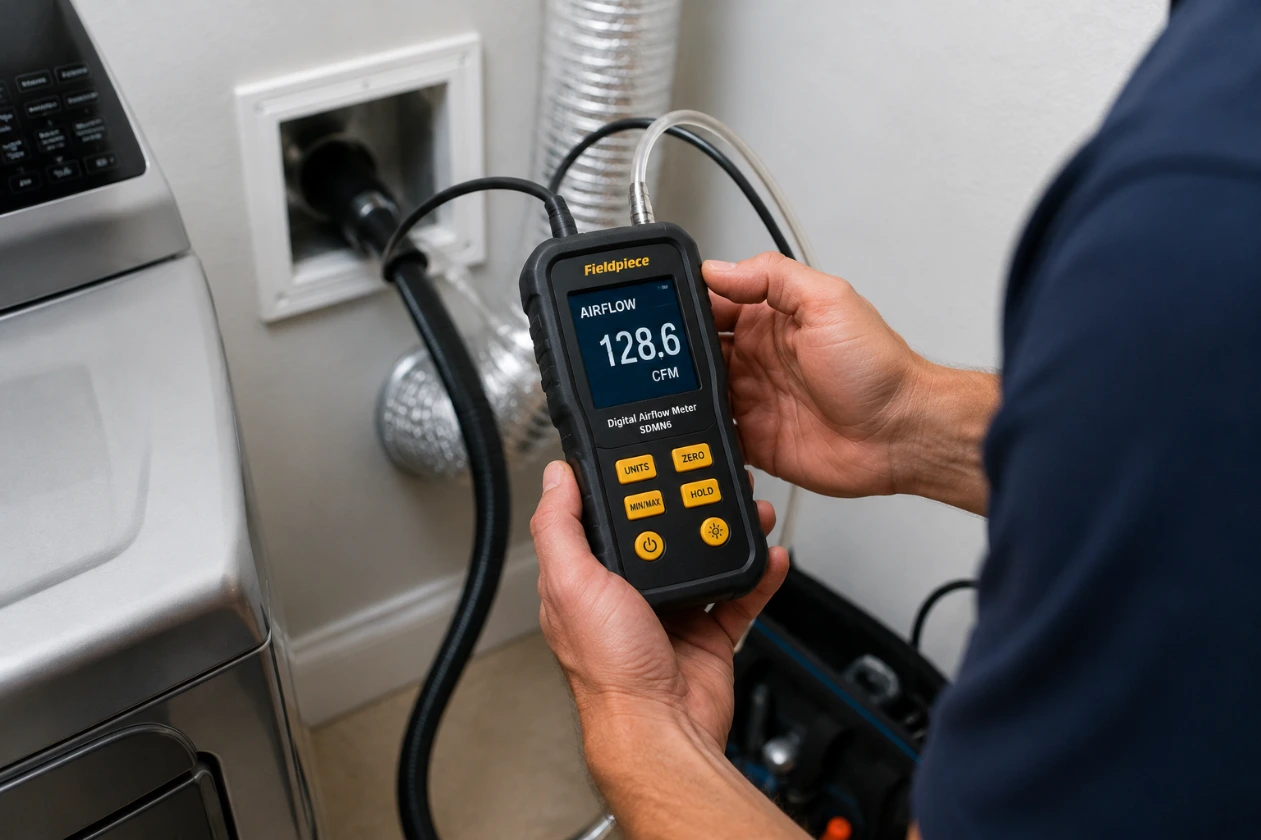
Airflow is measured in feet per minute (FPM) at the vent, which converts to CFM (cubic feet per minute) based on your duct’s diameter — for a standard 4-inch dryer duct, the accepted minimum for healthy airflow is around 105 CFM.
Below that, lint has more time and more still air to settle in as it moves through the duct, which is exactly the condition that leads to blockage and, eventually, fire risk. We measure this with a real instrument at the vent exhaust, not a guess based on how the dryer sounds or how long a load takes.
What the Inspection Actually Checks
- 1
Airflow reading at the termination point. A real FPM/CFM measurement, not an estimate.
- 2
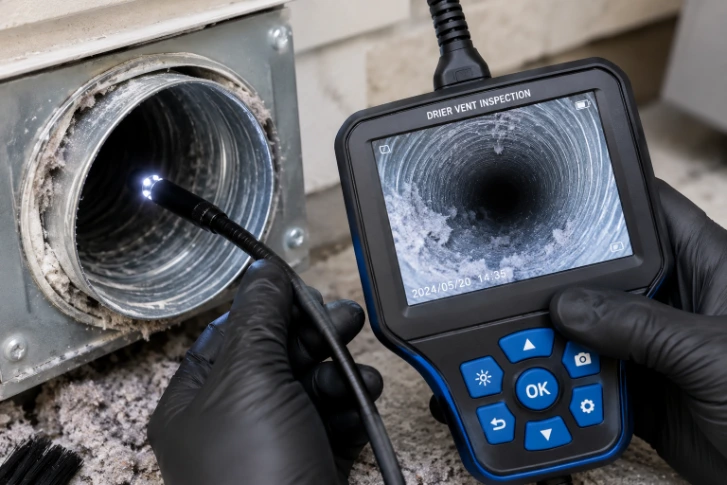
Full accessible vent run inspection. Checking for crushed or kinked sections, disconnected joints, and sagging in flexible sections.
- 3
Duct material assessment. Modern code calls for rigid or semi-rigid metal ducting with a smooth interior; older flexible ribbed ducting (common in historic-district homes and older sections of Ponte Vedra, Fairfield, and similar communities) is both a fire hazard and prone to trapping more lint than smooth rigid duct.
- 4
Run length and bend count. Run length and bend count matter too — see our repair & installation page for the full developed-length code rule with a worked example.
- 5
Termination point condition. Hood/cap condition, presence of a backdraft damper, absence of a screen (screens are prohibited at dryer vent terminations under code because they trap lint), and clearance from other building openings.
- 6
Exterior hood and weather-seal check. Especially relevant for coastal properties where salt-air corrosion is a factor.
When Inspection Only Makes Sense
An inspection-only visit makes the most sense in a few situations: you’re closing on a new home and want to know what you’re inheriting, you had a cleaning done somewhere else recently and want a second opinion, or you’re simply not sure yet whether the problem is your vent or your dryer itself. It’s also the right first move if you just want a baseline reading before deciding on a full cleaning.
Why This Matters at Closing
Dryer vent issues are a genuinely common home inspection finding, and they’re not always caught by a general home inspector, whose scope typically doesn’t include a real airflow measurement.
The issues that show up most often in real estate transactions include: vents terminating in crawlspaces or attics instead of fully outside (which deposits moisture and creates mold risk rather than solving it), screens installed at the termination that trap lint, terminations placed too close to windows or other building openings, missing backdraft dampers, and vent runs that are simply too long or too convoluted for the dryer to push air through effectively. National fire data attributes 13,800+ home fires a year to failure to clean dryers, making it the leading cause — a number that makes a pre-closing inspection a genuinely useful, not overly cautious, step.
A general home inspector will typically note visible issues but won’t give you an actual airflow number. We will — which means you’re not relying on a visual guess when deciding whether a vent system you’re about to inherit needs immediate attention or can wait.
What a Bad Reading Looks Like
Airflow readings vary by vent length and setup, but a reading that’s noticeably below what’s expected for your configuration — especially paired with visible lint at the exterior hood or restricted airflow you can feel by hand — tells us the line needs clearing. We’ll walk you through the number in plain terms, not just hand you a report full of jargon.
Segmentation by Situation
Home Buyers (Pre-Closing)
An inspection-only visit gives you a real number and a written record before you own the problem — useful both for your own decision-making and as a potential negotiating point if a significant issue turns up.
Second-Opinion Requests
If a cleaning was done elsewhere and you want to confirm it was actually effective, we test airflow independently rather than just taking the prior service’s word for it.
Dryer-vs-Vent Troubleshooting
If your dryer isn’t performing well and you’re not sure whether the problem is the appliance or the vent system, an airflow reading tells you definitively whether the vent side is restricted.
Older or Historic-District Homes
Given how common multi-year (or multi-decade) service gaps are in downtown St. Augustine’s older housing stock, an inspection is often a more useful first step than assuming a standard cleaning will fully address whatever’s actually going on with the duct.
Post-Renovation Verification
If a vent run was altered during a remodel — common in historic homes with converted attic spaces or relocated laundry rooms — an inspection confirms the new configuration actually meets minimum airflow standards.
What Inspection Service Costs
Inspection-only visits are priced lower than a full cleaning, reflecting the more limited scope (diagnostic assessment rather than clearing and cleaning). If an inspection reveals that a full cleaning is needed, we’ll quote that separately and you decide whether to proceed — there’s no obligation to book additional service just because you started with an inspection. Pricing for the inspection itself doesn’t vary much by home type, since the core process (airflow measurement, visual check, termination assessment) is largely the same regardless of run length; longer or harder-to-access runs may take somewhat longer to fully assess.
Frequently Asked Questions
Can I get an inspection without booking a full cleaning?+
Yes, inspection-only visits are available, and we’ll tell you honestly if cleaning isn’t needed yet.
Is an inspection a good idea before buying a home?+
Yes — dryer vent issues are a common but not always fully assessed home inspection finding, since a general inspector typically won’t take an actual airflow reading. An inspection gives you a real number before you own the problem.
How is airflow actually measured?+
With a real instrument at the vent exhaust — we measure air velocity and calculate the equivalent airflow rate, then compare it to the expected minimum for your duct size and configuration.
Does an inspection tell me if my dryer or my vent is the problem?+
Yes — a restricted airflow reading points to the vent; a normal reading with continued poor dryer performance points toward the appliance itself.
What’s a “good” airflow number, and what’s concerning?+
For a standard 4-inch duct, the generally accepted minimum for healthy airflow is around 105 CFM. Below that — especially combined with visible lint at the exterior hood — indicates restriction that needs to be cleared.
My home has an unusually long vent run — does that automatically mean a bad reading?+
Not automatically, but it does lower the safe ceiling. See our repair & installation page for the full length-and-bend code rule with a worked example.
Can an inspection catch problems a general home inspector would miss?+
Often, yes. A general home inspector’s scope usually doesn’t include an actual airflow measurement — they’ll note visible issues but won’t quantify how restricted the airflow actually is. We test the number directly.
If the inspection finds a problem, do I have to book the cleaning through you?+
No — there’s no obligation. We’ll give you the honest assessment and a quote if cleaning is needed, and it’s entirely your decision how to proceed.
Book an Inspection
A real airflow number and a straight answer — no obligation to book more.
Call (904) 937-8383