Commercial Dryer Vent Cleaning
Commercial laundry equipment runs harder and longer than a home dryer, which means higher fire risk and maintenance need. We work with business types across St. Johns County that can’t risk it.
Businesses We Work With
Laundromats
High-volume dryers running most hours of the day.
Salons
Towel dryers that run constantly between clients.
Nursing Homes & Assisted Living Facilities
Where fire code compliance isn’t optional.
Medical Offices
Smaller-scale but still regulated laundry equipment.
HOA-Managed Shared Laundry Facilities
Common areas serving multiple residents.
The Fire Code Landscape Behind This Service
Dryer vent fires aren’t a minor commercial hazard — industry fire data consistently identifies clogged dryer vents as a leading cause of fires at commercial and industrial properties, with tens of thousands of such fires reported annually across the country.
Commercial facilities operate under fire codes that residential properties don’t, most notably standards published by the National Fire Protection Association (NFPA), including NFPA 211 (chimneys, fireplaces, and vents) and, for healthcare occupancies specifically, NFPA 101 (the Life Safety Code), which governs nursing homes and assisted living facilities and is actively enforced through state licensing and inspection processes in Florida.
What this means in practice: a laundromat or healthcare facility that gets flagged during a fire marshal inspection for vent maintenance isn’t dealing with a suggestion, it’s dealing with a compliance finding — one that can affect licensing, insurance, and in the case of healthcare facilities, survey outcomes tied to continued operation. We’re not a substitute for your facility’s compliance officer or fire marshal relationship, but we document every visit specifically so you have a maintenance record to show if you’re ever asked for one.
Our Process for Commercial Facilities
- 1
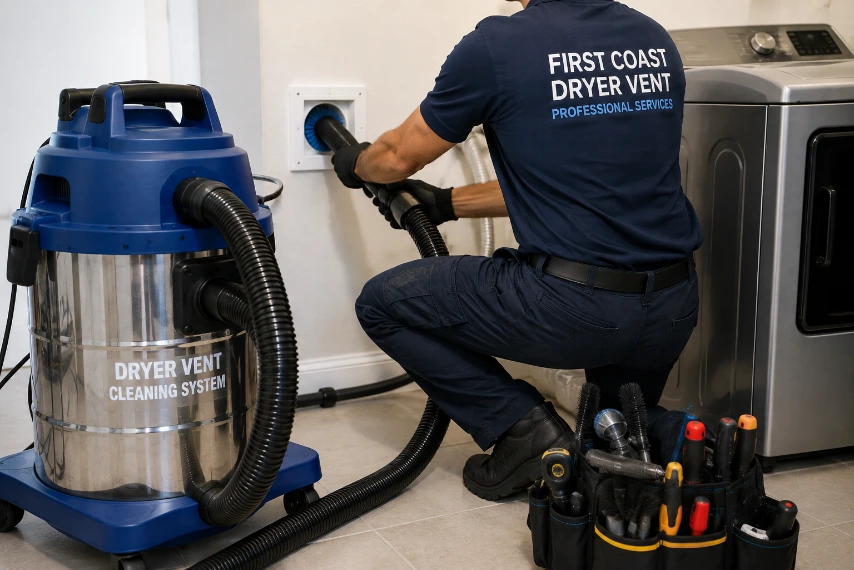
Initial facility walkthrough. Before the first cleaning, we walk your facility, count and assess your units, and look at site access — this is also when we give you a real quote, not a generic commercial rate.
- 2
Scheduling around your operating hours. We work out a service window that doesn’t cost you business — early morning, after close, or a slow period specific to your operation.
- 3
Unit-by-unit cleaning. Each dryer’s vent line is cleaned individually, since commercial units often run on separate duct paths even when they’re installed in a bank.
- 4
Shared/manifolded duct systems. Some commercial installations (common in laundromats and larger facilities) tie multiple units into a shared exhaust manifold — these require a different cleaning approach than individual residential-style runs, since a blockage anywhere in the shared line affects every unit connected to it.
- 5
Termination and rooftop/exterior inspection. Same code checkpoints as our residential rooftop service (backdraft damper present and functioning, no screen at the termination, proper clearance from other openings) — commercial terminations are held to the same standards, just at commercial scale.
- 6
Documentation. Every commercial visit is documented — what was serviced, what was found, and any compliance-relevant observations — so you have a record for your own files or for a fire marshal/inspector if needed.
- 7
Schedule recommendation. Based on what we find and your facility type, we recommend a service interval — which may be more frequent than annual for high-use facilities — and can set up a recurring schedule if you don’t already have one.
Compliance & Fire Code Considerations
Commercial fire code often requires more frequent vent cleaning than a home would. Depending on your facility type and local fire code, commercial dryer vents may need service more than once a year — laundromats and healthcare-adjacent facilities in particular. We can work with your existing maintenance schedule or set one up if you don’t have one yet, and we’ll flag anything during a visit that looks like it could be a compliance issue before it becomes an inspection problem.
Segmentation by Facility Type
Laundromats
The highest-use category we service — dryers running most operating hours means lint accumulates far faster than in any residential setting. Industry guidance commonly recommends quarterly service for high-volume laundromat equipment rather than the annual standard for a home; we’ll assess your actual usage and recommend an interval based on it rather than assuming.
Salons
Towel dryers running constantly between clients create a steady, high-frequency lint load even though individual loads are smaller than a laundromat’s. We schedule around your appointment book, typically early morning or a slow weekday.
Nursing Homes & Assisted Living
Fire code compliance here is enforced through state licensing (Florida’s Agency for Health Care Administration) and life-safety inspection processes, not just a general best practice — a finding during a survey can have real consequences for the facility. We document these visits with that context in mind.
Medical Offices
Smaller-scale laundry equipment (linens, scrubs) that’s still subject to regulatory oversight even though volume is lower than a laundromat or healthcare facility’s main laundry operation.
HOA-Managed Shared Laundry Facilities
Multiple residents’ usage concentrated on shared equipment means these units see more cumulative use than any single residential dryer — similar logic to a small-scale laundromat. We coordinate directly with HOA management or property management on scheduling.
Scheduling Around Business Hours
We know a laundromat can’t just shut down mid-day, and a salon can’t lose an hour of towel service on a Saturday. We schedule commercial jobs around your slow periods — early morning, after close, or whatever window works for your operation — so the service doesn’t cost you business.
Commercial Pricing Structure
Commercial pricing depends on the number and type of units, how often service is needed, and site access. We’ll walk your facility, look at your equipment, and give you a real number — not a generic “commercial rate” that doesn’t reflect what your business actually needs.
Why This Matters More Than a Generic Duct-Cleaning Vendor
A lot of commercial duct-cleaning vendors treat dryer vent service as an afterthought bundled into broader HVAC or kitchen-hood cleaning contracts, without facility-type-specific knowledge of what a laundromat’s shared manifold system needs versus what a nursing home’s compliance documentation requirements are. We treat commercial dryer vent service as its own specialty, because the failure mode — a fire in a high-occupancy or 24-hour-operating facility — carries different stakes than a missed cleaning in a single-family home, and the code framework governing it (NFPA standards, state healthcare licensing, local fire marshal inspection) is different too.
Frequently Asked Questions
How often should a commercial dryer vent be cleaned?+
Often more than once a year — high-use facilities like laundromats may need quarterly service.
Can you work around our business hours?+
Yes — we schedule around your slow periods so service doesn’t cost you business.
Do you service HOA shared laundry rooms?+
Yes — we coordinate directly with HOA or property management on scheduling for shared facilities.
Is commercial service more expensive than residential?+
It depends on unit count, type, and access — we give you a real number after walking your facility rather than a flat “commercial rate.”
What fire code actually applies to my facility?+
It depends on your facility type. Healthcare facilities like nursing homes and assisted living communities fall under NFPA 101 (the Life Safety Code) and Florida’s AHCA licensing requirements. Other commercial properties are typically governed by general fire and building code plus any requirements your local fire marshal applies. We’re not your compliance authority, but we document every visit so you have records if you’re asked for them.
Do you provide documentation we can show an inspector or fire marshal?+
Yes — every commercial visit includes documentation of what was serviced and what was found, which you can keep on file for compliance purposes.
We have multiple dryers tied into one shared exhaust system — is that serviced differently?+
Yes. Shared or manifolded duct systems, common in laundromats and larger facilities, require a different cleaning approach than individual runs, since a blockage anywhere in the shared line affects every connected unit. We assess this during your initial facility walkthrough.
Can you set up a recurring maintenance schedule instead of us calling every time?+
Yes — this is common for laundromats, healthcare facilities, and HOA shared laundry rooms. We can set up a recurring schedule based on your facility’s actual usage and any applicable compliance interval.
Book Commercial Service
Scheduled around your operating hours, with documentation for compliance.
Call (904) 937-8383