
Rooftop & Sidewall Dryer Vent Cleaning
Not every dryer vent ends at ground level, and St. Augustine has more roof-mounted vents than a lot of places thanks to how many multi-story and coastal homes are here. Here’s how we handle both types.
Rooftop Access & Safety
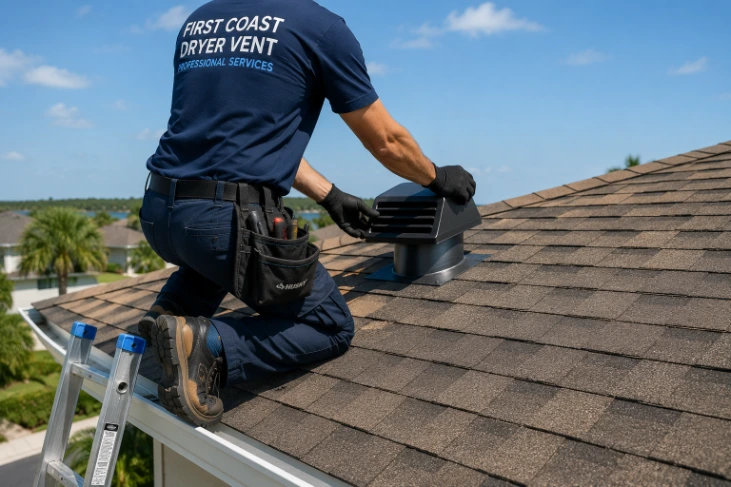
Roof vents need a technician on the roof with proper safety equipment — this isn’t a job for a ladder and a shop vac.
Roof-mounted vents are common on multi-story homes, especially closer to the coast in Vilano Beach and Anastasia Island. Servicing one properly means getting on the roof safely, clearing the termination point, and checking the full vertical run for sagging or moisture damage — something that’s both harder and riskier to do without the right gear.
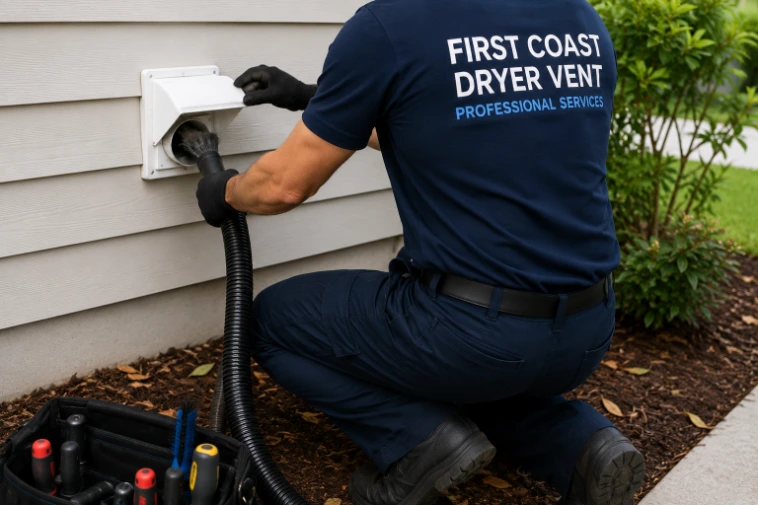
Sidewall Vent Service
Sidewall vents are the more straightforward job — ground-level access, a shorter typical run, and usually the quicker of the two services. Most single-story homes and a good number of two-story homes in St. Augustine use sidewall venting, and it’s generally the easier setup to keep well-maintained.
A few homes in our area use less common setups worth knowing about. PVC foundation vents run the exhaust line through a foundation penetration rather than a wall or roof — common in some slab-built homes. Sidewall extension vents use an extended sidewall routing to reach an exterior wall when the dryer isn’t located near one. Both setups have their own lint-trapping quirks, and we service both as part of our standard inspection.
Multi-Story Home Considerations
A multi-story home often means either a longer vertical sidewall run or a full roof termination, and either way, that added length gives lint more surface area to build up on before it ever gets outside. Multi-story homes should generally stick to the tighter end of the annual cleaning schedule rather than stretching it.
For especially long or multi-bend runs, some multi-story installations use an inline booster fan to keep airflow moving all the way to the termination point. If your home has one, we inspect and clean the booster fan housing as part of the service, not just the duct itself.
Salt Air & Corrosion
Anywhere within a few miles of the coast — Vilano Beach, Anastasia Island, St. Augustine Beach — exterior vent hoods and roof flashing take extra wear from salt air. We check hood condition on every visit in these areas, since a corroded cover isn’t just a cosmetic issue, it’s an entry point for pests and reduces how well the vent seals against weather.
Frequently Asked Questions
How do I know if my vent is roof-mounted or sidewall?+
Check the exterior wall near your dryer — if there’s no vent cover there, it’s likely routed to the roof.
Is roof vent cleaning more expensive?+
Yes, it requires more time and safety equipment than a standard sidewall cleaning.
Do multi-story homes need cleaning more often?+
Often yes, since longer runs give lint more distance to build up along before reaching outside.
Does salt air really damage vent hoods?+
Yes, coastal homes see faster corrosion on exterior metal vent fixtures than homes further inland.
Book Rooftop or Sidewall Service
Roof-access equipment for the tall ones, quick turnaround for the ground-level ones.
Call (904) 937-8383