
Dryer Vent Cleaning Glossary
A few terms come up on almost every call we take. Here’s what they actually mean, in plain language.
Dryer Vent Cleaning Glossary
A few terms come up on almost every call we take. Here’s what they actually mean, in plain language.
CFM / FPM (Airflow Reading)
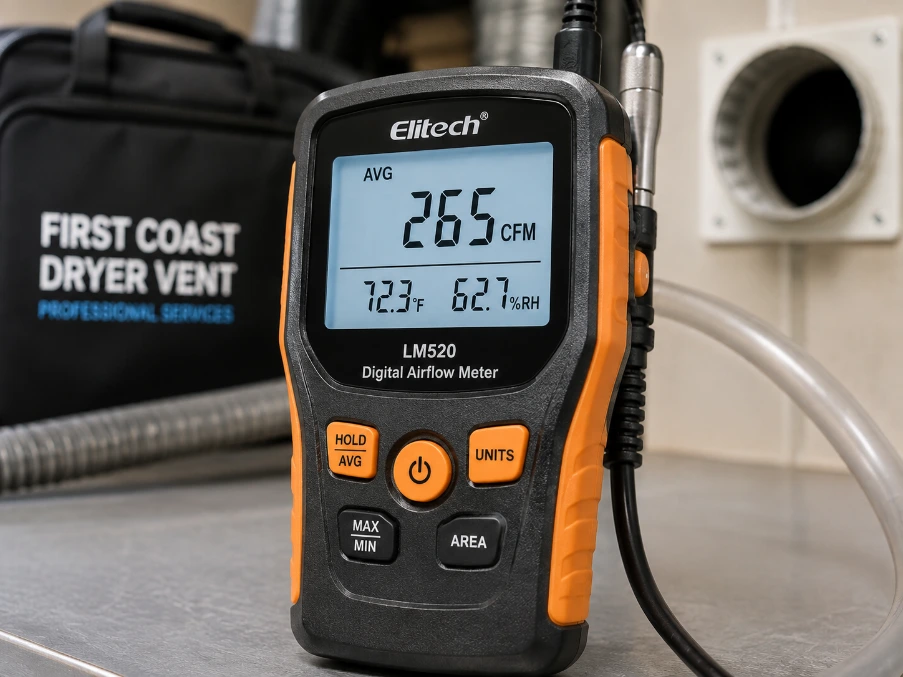
CFM (cubic feet per minute) and FPM (feet per minute) are both ways of measuring how much air is actually moving through your vent. We use an FPM reading before and after a cleaning so you can see a real, comparable number instead of just being told the job “looks good.”
Negative-Pressure Vacuum Extraction
The main method we use to actually pull lint out of your vent line — a vacuum system that creates negative pressure inside the duct, drawing loose lint toward the machine instead of just pushing it further down the line the way a leaf blower can.
HEPA Filtration
A filtration standard used in some of our equipment to capture fine dust and lint particles during extraction, rather than recirculating them back into your home’s air while we work.
Booster Fan
A small inline fan sometimes installed on unusually long dryer vent runs to help push air (and lint) the extra distance to the exterior termination point. Not every home needs one, but it’s a real solution for homes where the vent run exceeds what code typically allows without added airflow assistance.
Lint Screen / Exterior Lint Hood
The lint screen is the removable filter inside your dryer that catches most (not all) lint before it enters the vent line. The exterior lint hood is the cover at the outside end of the vent where air exits your home — this is the part that can trap birds, insects, or debris if it’s damaged or missing a screen.
Rigid vs. Flexible Duct
Rigid or semi-rigid metal duct has a smooth interior that resists lint buildup and holds up well to heat over time — the current recommended standard, especially in humid climates. Flexible foil or plastic hose is cheaper and easier to install but catches lint more easily at every ridge and fold.
Thermal Shutoff
A dryer’s built-in safety feature that cuts heat when internal temperatures get too high, often triggered by restricted airflow from a clogged vent. It’s designed to prevent overheating and fire, but it can also look like a “no heat” appliance problem to a homeowner who doesn’t know the cause.
Vent Re-Routing
Changing the physical path of a dryer vent line, usually to shorten an overly long or bent run — common after a remodel that moved a laundry room or dryer without adjusting the original venting plan.
Equipment We Use
Every term above ties back to real equipment we bring on every job — rotary brush systems, airflow meters, HEPA-filtered extraction units, and inspection cameras for the runs you can’t see into.
Frequently Asked Questions
What does FPM mean in dryer vent cleaning?+
Feet per minute — a measurement of how fast air is moving through your vent line.
Do all homes need a booster fan?+
No, only vent runs that exceed standard length limits typically need one.
What’s the difference between a lint screen and a lint hood?+
The screen is inside your dryer; the hood is the cover at the exterior end of the vent line.
Book a Service That Uses This Equipment
Now you know the terms — here’s the real thing, at your home.
Call (904) 937-8383