
Residential Dryer Vent Cleaning
Most of our work is exactly this — a homeowner, a neglected or acting-up vent, and a laundry room we’re in and out of in under an hour. Here’s what residential service looks like.
A Full Inspection, Cleaning, and Airflow Test
Every residential visit starts with an airflow reading so we know what we’re working with, moves into clearing the interior duct and the exterior vent hood, and ends with a second airflow reading so you can see the difference in real numbers. We photograph what comes out, and we put your dryer and any access panels back exactly where they were.
Our Full Process, Step by Step
- 1
Initial airflow reading. We measure actual airflow before touching anything, so you have a real “before” number.
- 2
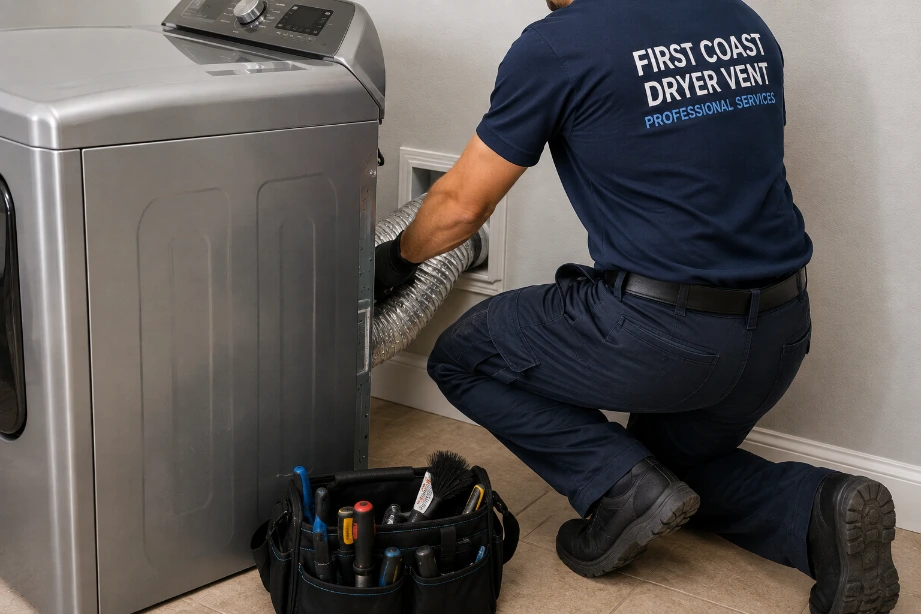
Dryer and access panel removal. We move the dryer (and pull stacked units forward where needed) to get full access to the vent connection point.
- 3
Interior duct clearing. The full accessible interior run is cleared of lint and debris, not just the section closest to the machine.
- 4
Exterior vent hood service. We clear and inspect the exterior termination — hood condition, backdraft damper function, and any pest or debris intrusion.
- 5
Post-cleaning airflow reading. A second measurement confirms the improvement in real numbers, not just a visual “looks better.”
- 6
Photo documentation. We photograph what came out of your vent, so you can see what was actually removed.
- 7
Reassembly. Dryer and access panels go back exactly where they were — we don’t leave you to reconnect anything.
For the full explanation of why dryer vent cleaning matters and the fire-risk science behind it, see our Why Dryer Vent Cleaning Is Important page — this page focuses on what the service itself involves.
Single-Family Homes
Most single-family homes in St. Augustine have a straightforward sidewall vent, and those are our quickest jobs — usually 30 minutes or so. Where it gets more involved is homes with additions or remodeled laundry rooms, where the vent sometimes got re-routed in a way that adds length or bends without anyone really planning it out. We see this a lot in neighborhoods that have had decades of renovations layered on top of each other.
Condos & Stackable Units
Stackable washer/dryer units in tight closets are some of the most commonly neglected setups we come across.
It’s rarely because anyone’s being careless — it’s just hard to get behind a stacked unit in a closet barely wider than the machines themselves. We come prepared for that, sometimes pulling the unit forward slightly to get full access to the connection point. If your unit has a magnetic quick-disconnect vent fitting, that makes the job faster; if it doesn’t, we still get it done, just with a bit more care.
Historic Home Considerations
St. Augustine has more genuinely old housing stock than most Florida cities its size — homes from the early 1900s sitting a few blocks from ones built last year.
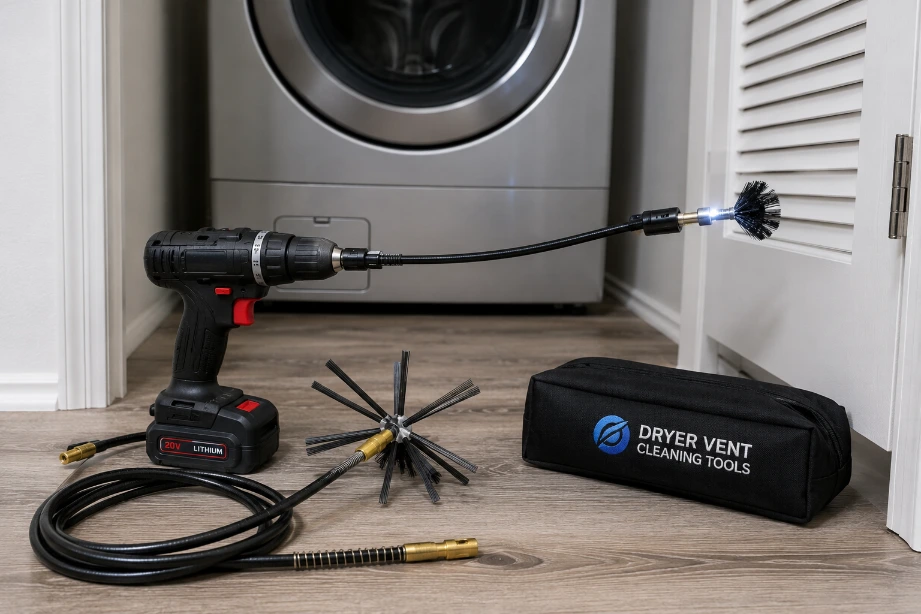
Older homes weren’t built with dryer venting in mind at all, since electric and gas dryers came along well after most of these houses did. That usually means longer runs, more bends, and sometimes a vent that goes up through a converted attic space before it ever reaches outside. These jobs take patience and the right length of equipment, not a rushed one-size-fits-all approach. For more depth on the specific historic neighborhoods this applies to — Lincolnville, Abbott Tract, Davis Shores — see our Historic District location page.
Additional Segmentation: New Construction
Not every St. Augustine-area home is old or historic — homes in World Golf Village, newer sections of Nocatee, and recent Ponte Vedra construction are on the opposite end of the spectrum: code-current ducting, straightforward runs, but sometimes larger dryer capacity that produces more lint per load than older, smaller units. New construction reduces the odds of a duct-age problem but doesn’t reduce the need for annual cleaning — we treat “brand new” the same as any other home when it comes to scheduling, just with a different set of things to check (proper installation rather than decades of wear).
How Often Residential Vents Need Cleaning
Once a year for most homes — Florida’s humidity means we don’t recommend stretching much past that, even for light use. See our full guide on cleaning frequency for the exceptions (larger households, pets, long or roof-mounted runs, rental properties) and the reasoning behind the annual standard.
Pricing: What Changes the Cost
- 1
Vent type and run length. A standard sidewall vent on a single-story home is our quickest, most affordable job; roof-mounted or long/multi-bend runs cost more given the added time and equipment.
- 2
Access. Stackable units in tight closets or dryers in hard-to-reach spots may add time.
- 3
Condition. A vent that’s gone multiple years without service, common in older homes with unknown history, may need more thorough clearing than a routine annual visit.
- 4
Bundled services. Adding bathroom exhaust cleaning to the same visit is usually more efficient and cost-effective than booking it separately, since a technician is already on-site.
We don’t do generic flat-rate quotes sight-unseen for anything beyond a standard, straightforward home — but most single-family sidewall jobs fall into a predictable, quick range, and we’ll tell you upfront if your specific setup is likely to cost more before we arrive.
Why Choose Us Over a Generic Handyman or National Chain
Dryer vent fires aren’t rare or theoretical — NFPA data attributes roughly 13,800+ home fires a year to dryers, with failure to adequately clean the vent identified as the single largest cause (around a third of these fires). A generic handyman or a national chain technician dispatched from wherever’s available that day isn’t necessarily trained specifically on vent systems, doesn’t carry vent-specific inspection equipment (like an airflow meter), and won’t have worked the specific range of housing stock — from 1900s historic homes to brand-new World Golf Village construction — that a St. Johns County-only team has actually been inside. We test airflow before and after every visit specifically because “looks cleaner” and “is actually clear” aren’t the same thing, and the difference matters when the stakes are a house fire, not just a slow-drying load of laundry.
Frequently Asked Questions
How long does a residential cleaning take?+
Most jobs run 30 to 45 minutes, longer for roof vents or heavily clogged systems.
Do I need to be home during the visit?+
We can typically accommodate either way — ask when you book what works best for your situation.
Can you service a stackable unit in a tight closet?+
Yes — we come prepared for tight-access setups, including pulling units forward when needed to reach the connection point.
What if my home has an unusual or very long vent run?+
We handle these regularly, especially in historic-district homes — it takes more time and the right equipment, not a different type of service.
Is a brand-new home’s dryer vent really at risk, or is that just for old homes?+
New construction is at risk too — new ducting is properly installed but still accumulates lint at a normal rate, and larger modern dryers sometimes produce more lint per load than older, smaller units. Annual cleaning applies regardless of how new the home is.
Why do you test airflow before and after instead of just cleaning and leaving?+
Because “looks cleaner” isn’t the same as “is actually clear.” A real airflow reading confirms the job worked, rather than relying on a visual impression — this is the same standard we apply on our dedicated Dryer Vent Inspection service.
Do you photograph what comes out of the vent?+
Yes — every residential visit includes photo documentation of what was removed, so you have a record of the actual condition we found.
How is pricing determined before you even see my home?+
It’s not — we confirm final pricing based on your specific vent type, run length, and access once we’ve assessed it, though most standard single-story sidewall jobs fall into a predictable, affordable range we can estimate over the phone.
Book Residential Service
In and out in under an hour, with a real airflow number before and after.
Call (904) 937-8383