
Bathroom Exhaust Vent Cleaning
Your bathroom fan and your dryer vent have more in common than most people realize — both push moist air through a duct to the outside, and both collect buildup that keeps them from doing their job.
How to Tell Your Bathroom Fan Needs Cleaning
If your bathroom mirror stays fogged longer than it used to, or you’ve started noticing a musty smell that lingers after a shower even with the fan running, dust and lint buildup in the exhaust duct is a likely cause. It’s easy to miss because the fan itself still sounds like it’s working — the problem is downstream, in the line you can’t see.
CFM, and Why It Matters
A bathroom fan that sounds fine and a bathroom fan that’s actually moving enough air are two different things — duct restriction is the gap between them.
The industry standard (ASHRAE 62.2) calls for bathroom exhaust fans to move at least 50 CFM when run intermittently, or at least 20 CFM if the fan runs continuously. That number is the fan’s rated output at the unit itself — not what actually reaches outside once air has to travel through however many feet of duct, elbows, and a termination point your home’s layout requires.
A fan rated at 50 CFM pushing air through a restricted, lint-caked duct might be delivering a fraction of that by the time air actually exits the house. The motor doesn’t know the difference — it just runs harder and hotter trying to move air against the resistance, which is part of why a restricted bathroom exhaust duct is a fire risk, not just a comfort issue. We test actual airflow at the vent, not just fan operation, so you know whether your bathroom exhaust is really doing its job.
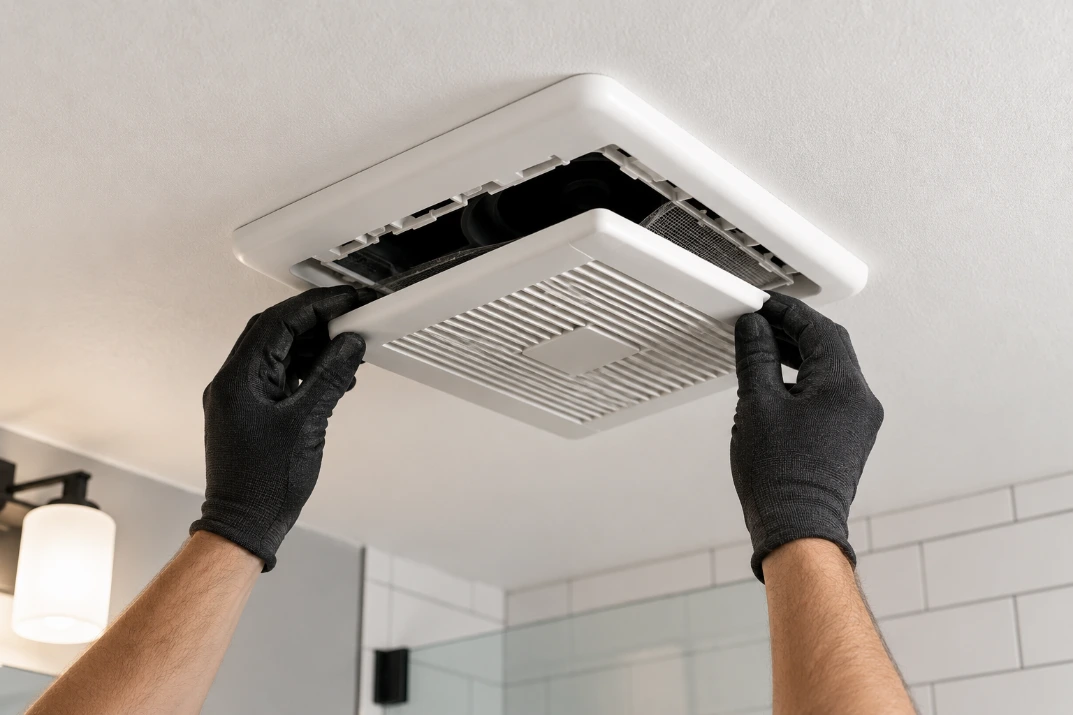
What a Bathroom Exhaust Cleaning Actually Involves
- 1
Fan cover removal and initial inspection. We remove the fan grille/cover and inspect the housing, motor area, and visible duct connection for lint buildup, dust, and any signs of moisture damage or mold around the fixture.
- 2
Motor housing cleaning. Lint and dust built up directly around the fan motor — the area most directly tied to the overheating fire risk — is cleared first.
- 3
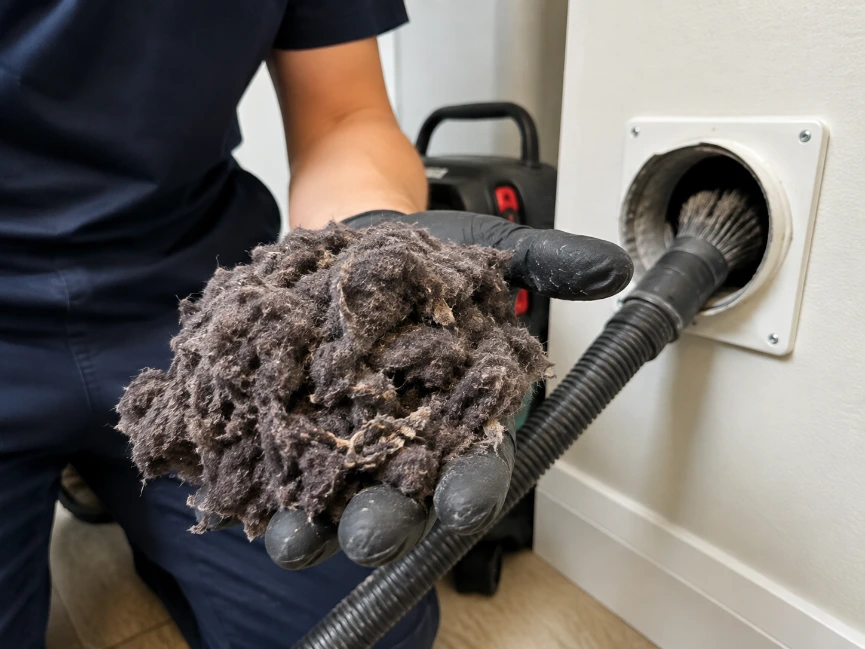
Duct line clearing. Using the appropriate equipment for your duct’s routing, we clear buildup along the full duct length, not just what’s visible from the fixture.
- 4
Termination point check. We inspect the exterior termination — roof cap, soffit vent, or wall cap — for blockage, damage, or nesting material, and confirm it’s positioned to code.
Why This Matters More in Older St. Augustine Bathrooms
A bathroom with limited natural airflow depends heavily on the exhaust fan actually doing its job.
When the duct is restricted, moisture lingers in the room longer after every shower — exactly the kind of ongoing dampness mold needs to take hold, especially in a humid climate like ours. This is especially relevant in the historic core of St. Augustine and Lincolnville, where original bathrooms were often small interior rooms without windows, built decades before mechanical exhaust ventilation was standard. In those rooms, the exhaust fan isn’t a backup to natural airflow — it’s the only airflow the room has. A restricted duct doesn’t just mean lingering steam; it means moisture has nowhere else to go.
How Bathroom Exhaust Service Differs by Property
Older Historic-District Homes
Interior bathrooms often rely entirely on mechanical exhaust with no natural ventilation backup. We treat duct condition here as higher priority given the total dependence on the fan working correctly.
Newer Construction
Bigger primary bathrooms in newer builds across World Golf Village, Nocatee, and Ponte Vedra sometimes have multiple exhaust points or longer duct runs to reach an exterior wall.
Vacation Rentals
Frequent guest use means bathroom fans run more often and see faster buildup than an owner-occupied home. See our Vacation Rental page for scheduling around turnover.
Multi-Bathroom & Commercial Properties
Larger homes and commercial properties often have multiple exhaust fans on a shared or near-shared duct system — see our Commercial page for how that’s scheduled differently.
Bundling With Dryer Vent Service
Since a technician is often already on-site working on your dryer vent, adding a bathroom exhaust cleaning to the same visit is usually the most efficient way to handle both. It’s a smaller job than a full dryer vent cleaning, and doing them together means one appointment instead of two.
What Bathroom Exhaust Cleaning Typically Costs
Bathroom exhaust cleaning is typically priced as an add-on when bundled with a dryer vent visit, since a technician is already on-site — usually the most cost-effective way to have it done. Standalone service is priced based on the number of exhaust fans being serviced, duct routing and length, and access. We confirm pricing before starting any work, and if we find something during the cleaning that goes beyond the original scope, we’ll walk you through it and get approval before doing anything additional.
Why This Matters More Than a Generic Franchise Realizes
A generic handyman service or national franchise technician dispatched to “clean a bathroom fan” is usually thinking about the fixture, not the full duct system behind it — and not about how that system interacts with the moisture and mold risk specific to older, smaller-floor-plan St. Augustine bathrooms, or the fire-risk math around motor overheating that a quick surface wipe-down doesn’t address. We treat bathroom exhaust cleaning as the same category of safety-relevant work as dryer vent cleaning, not a lesser add-on service.
Frequently Asked Questions
How do I know if my bathroom exhaust vent needs cleaning?+
Slow steam clearing and a lingering musty smell after showers are the two clearest signs.
Can this be done at the same time as dryer vent cleaning?+
Yes — bundling is the most common and most cost-effective way we do this work, since a technician is already on-site.
Does a clogged bathroom vent actually cause mold?+
Yes. A restricted duct means moisture from showers lingers in the room longer than it should, and in Florida’s humid climate that lingering dampness is exactly what mold needs to establish itself, especially in older interior bathrooms with limited natural airflow.
How often should a bathroom exhaust vent be cleaned?+
Most homes are fine on an annual schedule, bundled with dryer vent service. High-usage bathrooms — large households, frequent guest use, vacation rentals — may benefit from more frequent checks.
What’s the actual fire risk here — is this overstated?+
It’s not overstated. Lint buildup around a bathroom fan motor causes it to run hotter, and documented residential fires have started from exactly this. It’s a lower-profile risk than dryer vent fires, but it’s a real one, and it’s part of why we treat this as safety-relevant work.
My bathroom doesn’t have a window — is the exhaust fan more important in that case?+
Significantly more important. Many older St. Augustine and Lincolnville homes have small interior bathrooms with no natural ventilation at all, which means the exhaust fan is the only path moisture has to leave the room.
Is my fan actually moving enough air, or does it just sound like it’s working?+
Those are genuinely different things. Fan noise tells you the motor is running; it doesn’t tell you how much air is actually reaching the outside through the duct. We verify actual airflow at the termination point as part of our process.
Do you check the exterior termination point, not just the fan itself?+
Yes — we inspect the roof cap, soffit vent, or wall cap for blockage or damage, and confirm it’s positioned with appropriate clearance from air intakes per code.
Book Bathroom Exhaust Service
Quick, code-compliant work — bundle it with your dryer vent visit or book it on its own.
Call (904) 937-8383